

For 40 years I have been working as a champion for the voices of patients and public being heard in the process of commissioning and providing health and care services. I have been a passionate advocate for the idea that peoples’ lived experiences should be central to all decisions about health and care services and their rights should be properly respected. The principle that there should be ‘Nothing about us without us’ should be at the heart of all that we do.
One of the difficulties I have had over those years is the perception that all I do is point out the negatives, to highlight what is going wrong, to be carping and critical. That is indeed part of the role that I play in Healthwatch and increasingly in other places – I am there to challenge where I see clear inequities and poorer outcomes for patients and their carers.
I do however always seek to do so in a constructive and evidence-based way, I rarely if ever simply give my personal opinions even when they are based on observation and experience.
Critics say you always offer up problems, but where are the solutions? So in addition to the challenge role I have also sought to develop the support role. I have listened to the thoughts and ideas of patients, carers and residents about what commissioners and providers might be able to do to improve the situation.
I am fully aware that the larger issues such as demand outstripping capacity, finance, workforce, technology and estates can seem a bit overwhelming at times. However after many years of listening to the wants needs aspirations and fears of residents patients and carers I would like to offer up some thoughts which may be of some help.
I have summarised these thoughts into what is a deceptively simple framework.
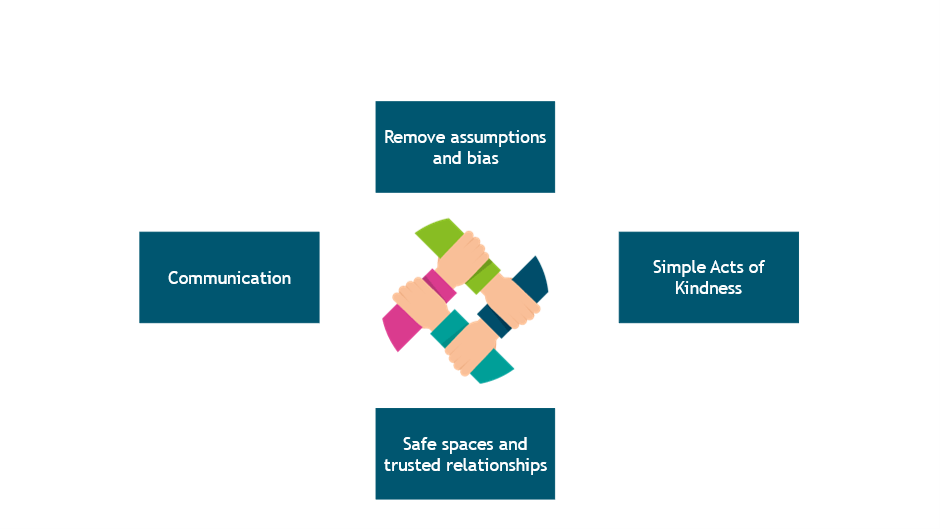
Assumptions and bias
This lies at the heart of ‘Nothing about us without us’. I have regularly heard over the years about care staff and clinicians assuming they know what is best for the person without involving them and hearing their voice. This leads to the most damaging outcome of all, a loss of trust. A few moments spent examining your own perceptions and fixed ideas can pay long term dividends. Not always an easy thing to do in a pressured situation but it is so important.
Communication
The impact of poor communication and inconsistent administration can hugely impact on the experiences and outcomes for patients. This applies to verbal and written communication across a whole range of circumstances. If you wish to communicate with people, check to make sure that you are doing so in ways that are most accessible to them. This has been the most consistent difficulty reported by patients year after year,
Safe space and trusted relationships.
People respond better when they feel safe and have trust in the person they are dealing with. If people are unwell this concept becomes even more important. People report that illness and strange environments add to their feelings of anxiety, especially in busy and noisy clinical environments. It can also an important for neurodiverse people where this effect can be magnified. Finding ways of achieving this is, of course, not always easy but it is something worth looking into.
Simple acts of kindness.
The experiences that people have can often be the product of a number of small human gestures. Simple acts of kindness can affect the way a patient experiences and views their entire journey, it can build trust and feelings of safety. A very small thing but it can have such a huge impact.
There is so much more that can be developed from each ‘arm’ of the framework. It is based on the cumulative experiences of patients, carers and public over many years and is intended to be helpful. To provide food for thought. I certainly hope it does.
 Chris Bain